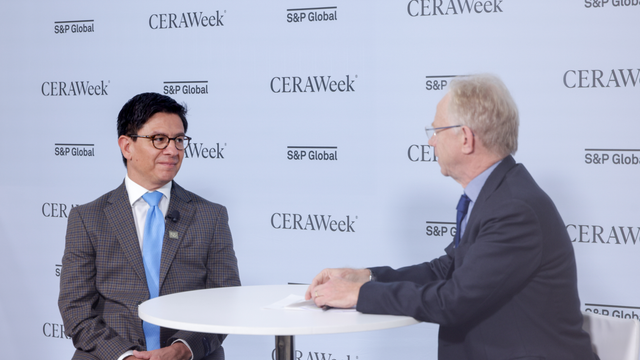
According to Charlie Sanchez, president of Black & Veatch infrastructure advisory, the power sector is undergoing a critical shift. In a conversation with S&P Global, he highlights the rising importance of grid orchestration in managing today’s rapidly evolving energy landscape.
As power demand accelerates, driven by AI software, data centers, electrification and industrial growth, utilities are facing a fundamental reality: building more generation alone will not be enough.
The industry is being pushed toward a new paradigm, one that requires end-to-end system thinking across the entire grid.
Drawing on Sanchez's insights, here are 5 ways grid orchestration will unlock a smarter, more resilient future grid.
1. It replaces siloed decision-making
For decades, utilities have planned and operated the grid in silos. Generation, transmission, distribution and customer‑side resources were optimized independently. That model no longer meets operational needs. Today’s grid is far more dynamic:
load is less predictable and more concentrated
DERs are proliferating at the grid edge
interconnection queues are growing faster than infrastructure
extreme weather is intensifying reliability risks
In this environment, localized optimization creates system‑wide inefficiencies. Solving a constraint in one part of the grid can create new risks elsewhere. Grid orchestration replaces siloed decision‑making with coordinated, system‑wide optimization, ensuring every action supports the health of the entire grid.
2. Empowers end-to-end system thinking
Grid orchestration represents a fundamental shift in how utilities plan operate and invest. Instead of treating each part of the grid as an isolated domain, orchestration enables utilities to view the system as an interconnected whole. This shift shows up several ways:
Coordinating across the full grid stack: breaking down barriers between generation, transmission, distribution, and the grid edge.
Integrating planning and operations: aligning long‑term investment decisions with near‑term operational realities.
Synchronizing decisions across time horizons: from real‑time operations to multi‑decade planning.
End‑to‑end system thinking ensures that decisions made in one part of the grid don’t create unintended consequences elsewhere. It’s the mindset shift that makes orchestration possible.
3. Flexibility becomes a resource
Grid orchestration means DERs, storage and demand response are no longer edge cases. They are core system assets—but only if they are orchestrated. Grid orchestration turns this distributed potential into dependable system value by enabling utilities to:
Treat DERs as dispatchable resources
Coordinate storage across multiple timeframes
Use demand response as a precision tool
Unlock flexibility to serve new load without new construction
In the context of rapid load growth, flexibility becomes the primary unlock that allows utilities to maintain reliability while accelerating electrification.
4. Grid orchestration maximizes existing infrastructure
With long lead times for new generation and transmission, utilities must get more out of the infrastructure they already have. Through better visibility and coordinated operations, grid orchestration helps utilities:
Accelerate interconnections without compromising reliability
Identify hidden hosting capacity
Optimize power flows to relieve constraints
Manage near‑term risks while planning long‑term upgrades
This is how utilities serve more load, faster without waiting years for new steel‑in‑the‑ground.
5. It creates a resilient data-driven grid
The future grid will not be defined by how much infrastructure we build, but by how effectively we coordinate and optimize it. Grid orchestration represents a critical step in that evolution. A data‑driven grid provides:
Unified, real‑time visibility
Advanced forecasting and analytics
Automated decision‑making
Customer‑integrated resilience
Risk‑informed planning
This is resilience redefined: not just stronger infrastructure, but smarter infrastructure.
The need is clear: utilities need technology and software that enable orchestration across distribution and transmission, integrate DERs through DERMS and ADMS, and keep electricity reliable, affordable and sustainable as the energy system evolves.