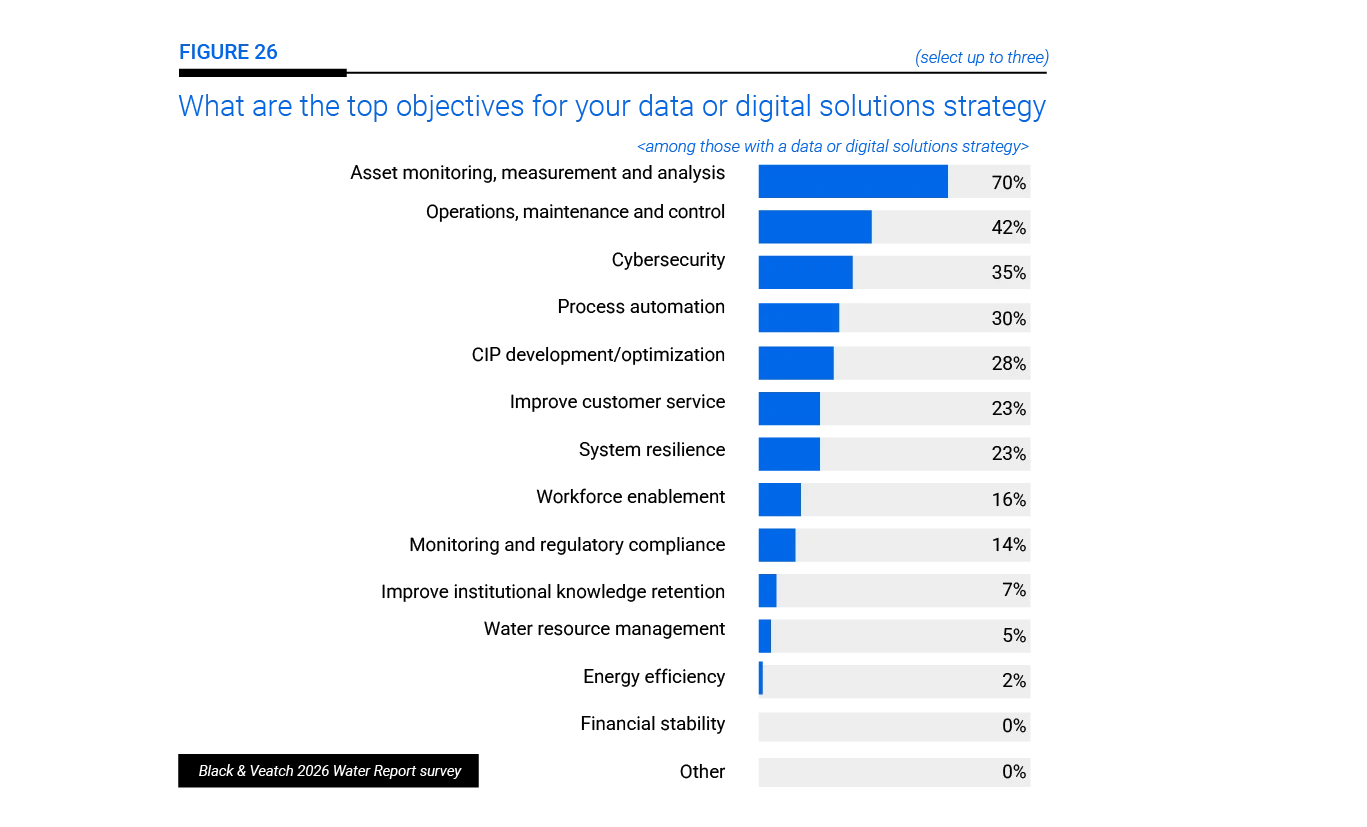
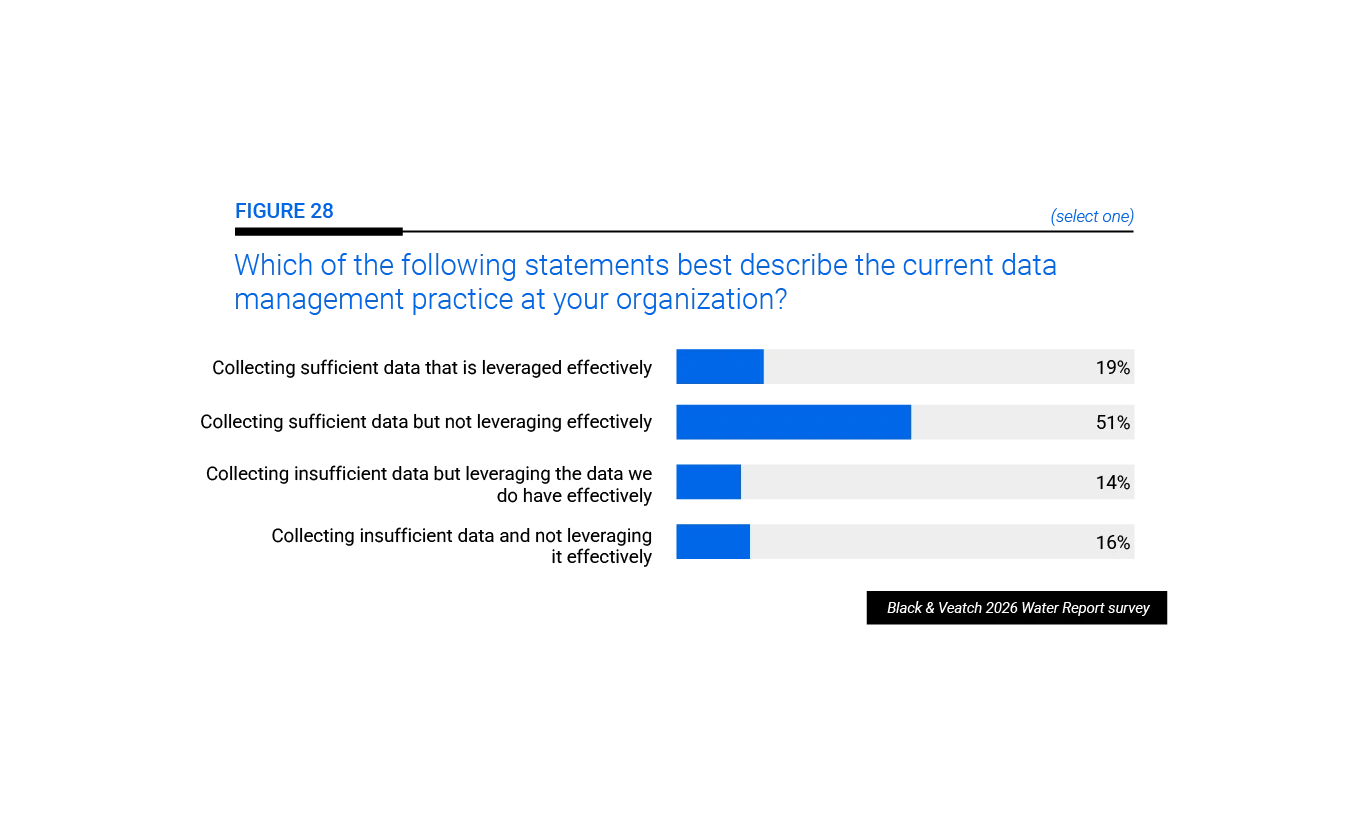
The question is whether the data being collected is good enough, organized enough and accessible enough to move the operational or financial needle. Unused data can represent stranded investment.
The asset information results help explain why the gap persists. Only 7% of respondents rate the quality of asset information in their enterprise asset management (EAM) or computerized maintenance management system (CMMS) as very good. Only 8% say the same for asset O&M costs, and only 10% rate asset condition and performance information as very good. Asset characteristics perform somewhat better at 19%.
The problem is that average or good data may be insufficient for high-confidence decisions about risk, lifecycle cost, predictive maintenance or capital prioritization.
Across several key asset data categories, fewer respondents rated their information as very good in 2026 than in 2025. That doesn’t necessarily mean utilities are getting worse. It may mean they have a clearer understanding of what decision-ready data requires. But it does show that the sector has not yet closed the gap between data collection and data value.
The digital disconnect
Digital tools can expand visibility, but visibility does not automatically change how decisions are made. In many utilities, systems are in place, but the underlying data is fragmented, inconsistent, manually maintained or organized around departmental needs. Engineering, operations and finance may each have a different view of asset condition, performance, cost and risk. When those views aren’t reconciled, coordinated decision-making becomes harder.
There is also a disconnect between why some data is collected and how it is used. Many utilities collect data because they always have or because a regulatory, operational or reporting process requires it. That’s different from collecting data with a defined decision in mind. The stronger question is not “What data do we have?” but rather “What decisions do we need to make, and what data would make those decisions more reliable?”
This is why asset management has become such a natural focal point for digital water. It connects data directly to decisions about performance, risk, cost and service reliability, shifting the emphasis from collecting more data to using better data in a defined decision process.
That also requires a better balance between data, process and institutional knowledge. Experienced staff will remain essential, but utilities cannot rely indefinitely on a shrinking pool of individual knowledge. They need to codify decision processes, capture operational context and ensure that data is reliable enough to support those processes. The objective is not to replace judgment. It is to make good judgment more repeatable.
Where execution meets workforce reality
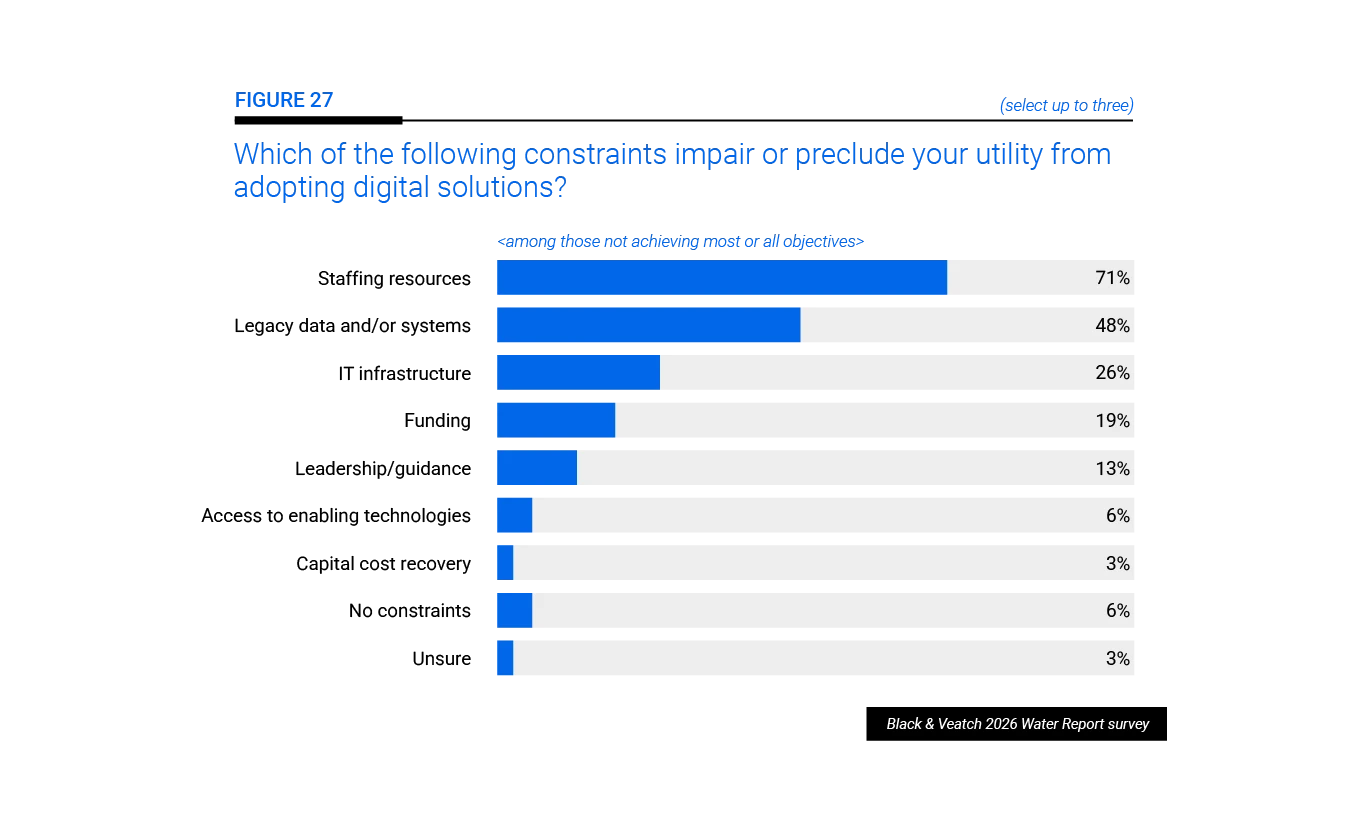
The staffing constraint reflects retirements and the loss of institutional knowledge. More broadly, it also reflects competition for talent, limited bandwidth, training needs and the challenge of making digital ways of working stick inside organizations that are already stretched.
The survey results reinforce this. Among respondents collecting insufficient data, workforce training is the most commonly cited barrier, at 59%, followed by lack of a platform (41%), ineffective mobile data collection (36%) and management buy-in (27%). Funding is a factor, but the results suggest the challenge is also about direction, tools, training, and execution.
The enablers tell the same story from the other side. Among respondents collecting sufficient data, 69% cite automated data collection, 53% cite user-friendly technology applications and platforms, 49% cite management buy-in and 47% cite workforce training. Sufficient data collection is both a technology outcome and a management-of-change outcome. In short: Technology adoption depends on organizational adoption.
Promising results need better quantification
Among respondents with mature digital programs, 78% cite operational improvements and 44% point to productivity gains. One-third cite measurable return on investment, and one-third cite attracting or retaining staff. The base is small, but the direction is clear: where execution is strong, digital programs are producing tangible benefits.
The gap is not value, it is communication and attribution. Operational improvement and productivity gains are forms of return, even without a formal return on investment (ROI) calculation. The sector needs to quantify those benefits in language that boards, regulators and customers understand: avoided emergency work, reduced failure risk, improved crew productivity, better capital targeting and improved reliability.
That matters for funding. If utilities cannot clearly communicate the value of digital investment, digital programs are vulnerable to being treated as discretionary — even when they are directly tied to better asset and financial outcomes.
Turning adoption into results
For many utilities, the next phase of digital water will be defined by whether data, systems, people and processes are aligned well enough to improve decisions.
Data visualization is a critical part of that alignment. The survey shows moderate expertise with familiar technologies such as GIS, CIS, AMI and CMMS. But expertise with data visualization, data integration and data warehousing remains closer to the middle of the 0-to-5 scale. Visualization improved from 2025 to 2026, but many utilities are still not fully fluent in turning data into decision-ready views. That matters because visualization is often what makes good data usable across departments.
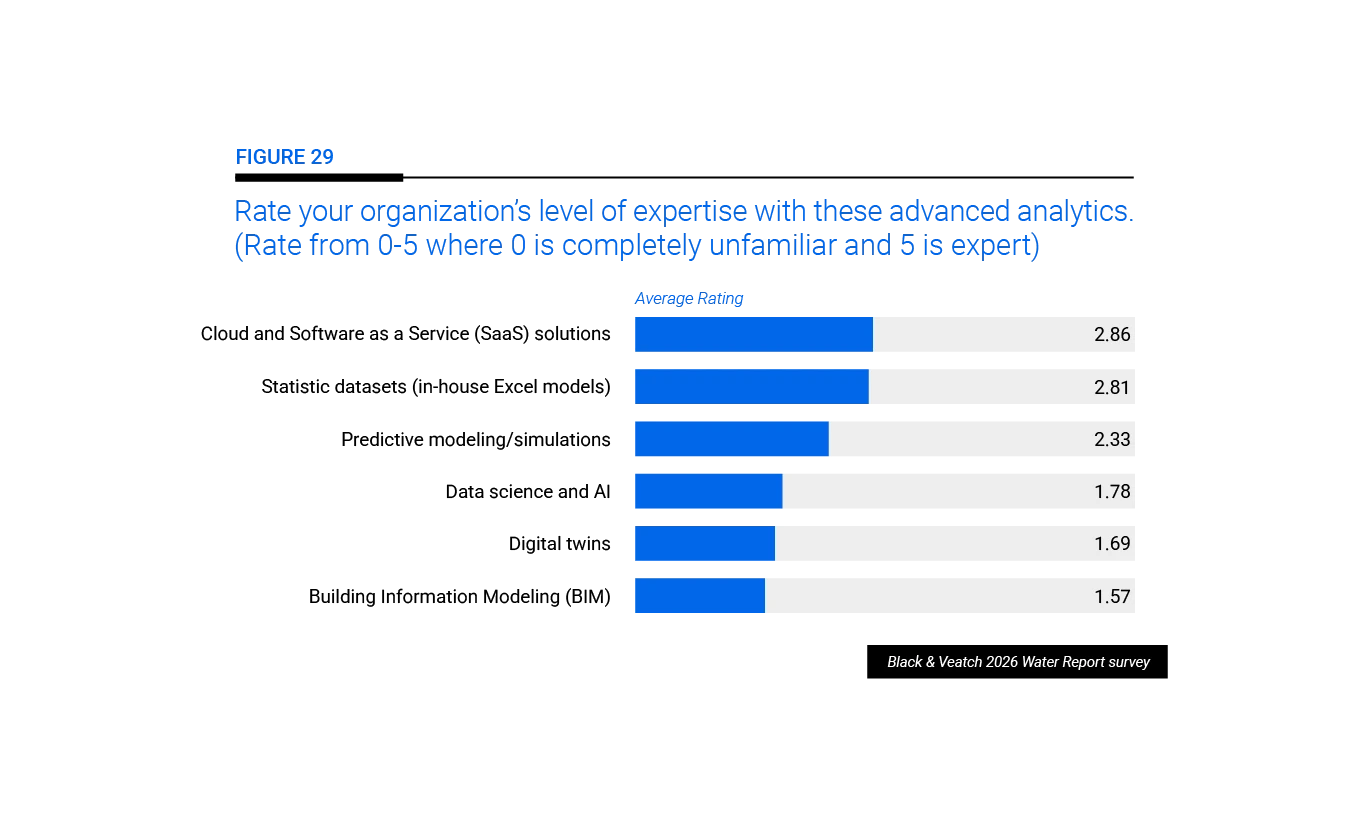
The same foundation will determine how quickly utilities can benefit from AI, digital twins and advanced analytics. Expertise in these areas remains low: data science and AI at 1.78, digital twins at 1.69 and predictive modeling/simulations at 2.33 on the same scale. AI will not solve poor data quality, fragmented processes or unclear decision rights. It will amplify whatever foundation exists beneath it.