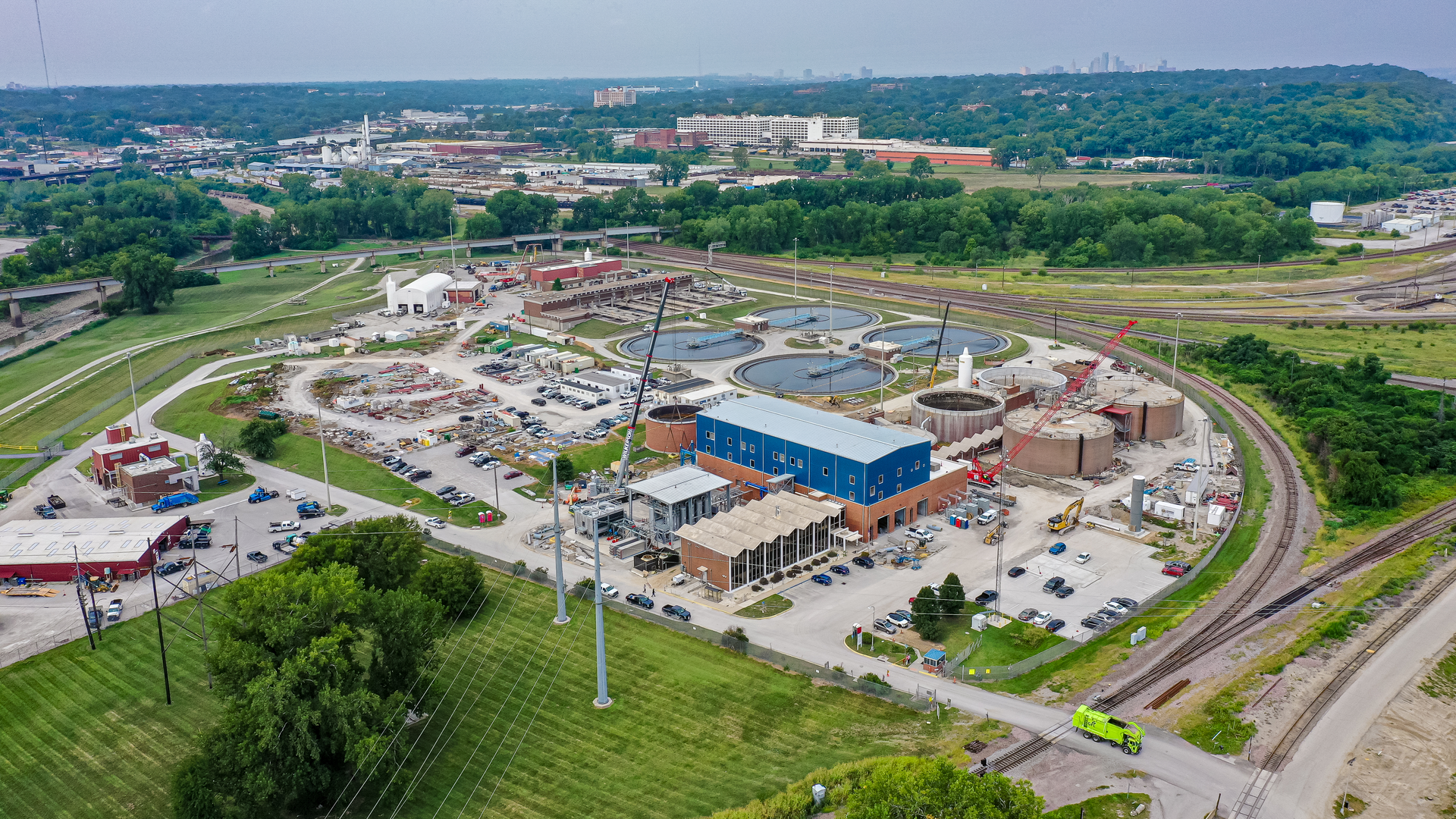
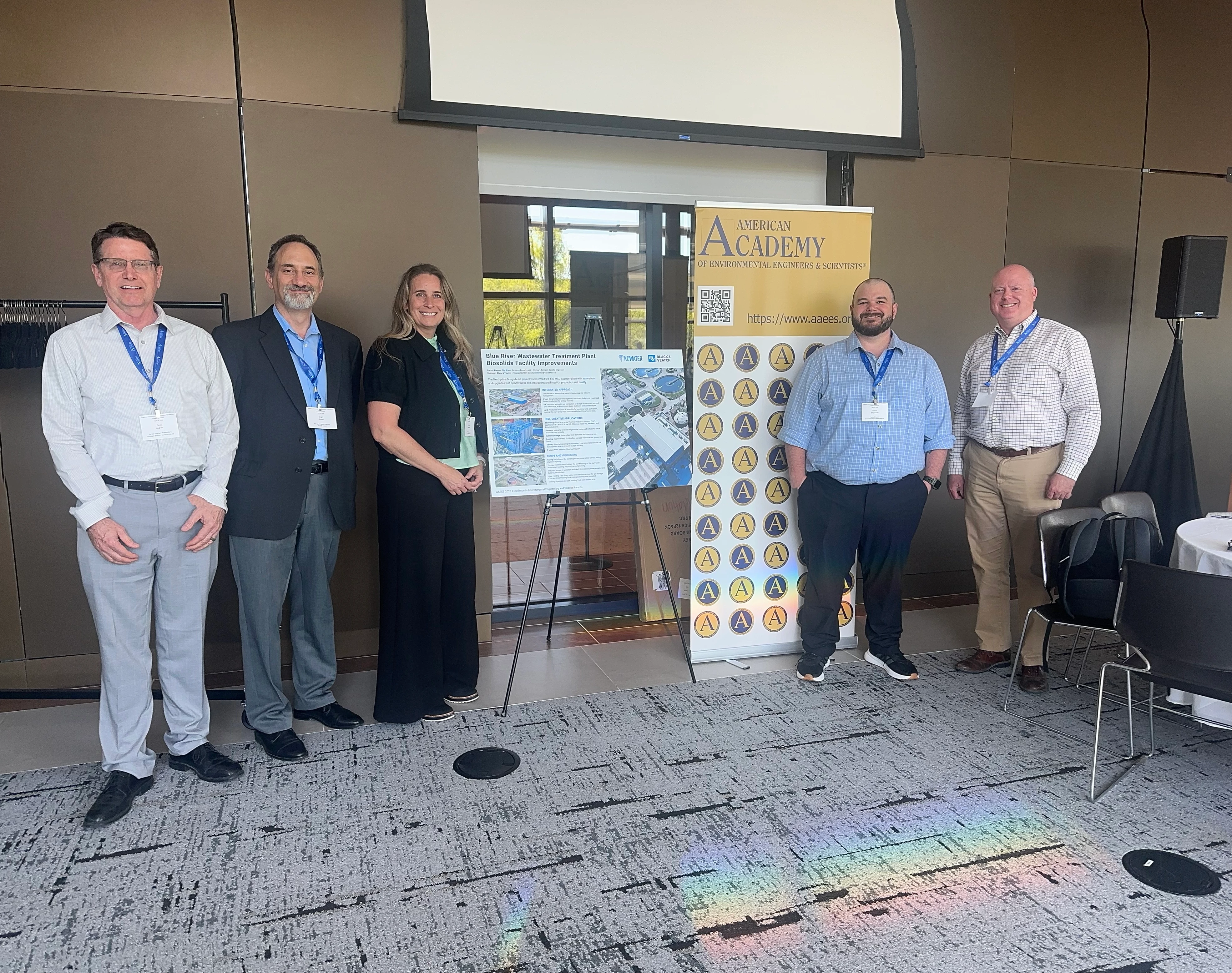
The Blue River Wastewater Treatment Plant (WWTP) biosolids facility improvements project in Kansas City, Missouri, has been named a recipient of the American Academy of Environmental Engineers and Scientists (AAEES) 2026 Excellence in Environmental Engineering and Science (E3S) Grand Prize Award. The honor recognizes leadership and excellence in delivering a complex, high-performance biosolids facility that replaces outdated infrastructure while maintaining continuous plant operations.
Delivered for the Kansas City Water Services Department, the project transforms the city’s largest wastewater treatment facility through the replacement of a 1960s-era incineration system with a modern thermal hydrolysis process (THP) and an advanced anaerobic digestion platform.
Black & Veatch served as designer under a collaborative design-build delivery model with Goodwin Brothers Construction, enabling close coordination between owner, designer and constructor throughout planning, design and construction.
The Blue River project serves as a replicable model for utilities seeking to modernize aging facilities under constrained conditions."
Suzie Carpenter, Black & Veatch project director
“Through design-build delivery, strategic reuse of existing infrastructure and integration of advance biosolids treatment technologies, the project demonstrates how thoughtful engineering and collaboration can extend asset life, improve performance and deliver long-term value for utility owners and the communities they serve.”
Modernizing critical biosolids assets at Kansas City’s largest WWTP
The Blue River WWTP has the capacity to treat 120 million gallons of wastewater per day and process biosolids, as well as solids from two additional city wastewater treatment plants.
The project replaced a legacy incineration system with one of the first large-scale THP systems in the Midwest, significantly improving digestion efficiency and biosolids quality.
The facility now can produce up to 94 dry tons per day of Class A biosolids, creating a stable, nutrient-rich product suitable agricultural and residential land application while reducing reliance on incineration and landfilling.
Design-build in a constrained, operational environment
The project was delivered using a design-build approach, allowing the team to manage technical risk, integrate constructability into design decisions and adapt solutions as site and operational constraints evolved. This delivery method was critical, given the complexity of the existing facility, the need for continuous operations and the integration of new processes into an active, multi-train plant.
Advanced building information modeling (BIM) supported design coordination, constructability and long-term asset management, helping the team optimize implementation, manage technical complexity and ensure operational continuity with reliable data. Construction and commissioning were carefully staged to allow the treatment plant to remain fully operational, including flexible, multi-step commissioning of the THP and digestion systems to protect biological processes and regulatory compliance.
The project team also navigated evolving state and local regulatory requirements, wastewater management priorities and stakeholder engagement needs over a multi-year development schedule, ensuring transparency and alignment with community and environmental priorities. Ongoing analysis, monitoring and control of data across systems — such as pumps, pipes, tanks, centrifuges, THP and other technologies — support effective wastewater management and maintenance planning.
Adapting the original footprint to enable efficient expansion
A defining feature of the project was the reuse and adaptation of the original incinerator footprint and existing infrastructure. The new biosolids facility was constructed on the foundation of the demolished incineration building, allowing the team to expand processing capacity while minimizing site impacts and avoiding major new civil construction.
Key elements of the existing facility — including digesters, holding tanks, corridors and structural foundations — were strategically reused or upgraded. This approach reduced construction risk, streamlined operations and maintenance, and enabled the plant to process more solids without adding new digester capacity.
Advancing resource recovery, operational performance
The upgraded biosolids process captures biogas generated during anaerobic digestion. Through another project now underway, the gas will be treated and made available for beneficial reuse through the natural gas system, contributing to reduced emissions and improved energy efficiency. Sidestream nutrient treatment was incorporated to manage high-strength ammonia flows generated by the enhanced digestion process, supporting permit compliance as biosolids capacity increased.
By eliminating incineration, the project delivers measurable environmental and operational benefits, including improved air quality, reduced residuals handling and lower long-term disposal costs.
Recognized for quality, innovation and performance
The AAEES ES3 Design Award recognizes projects that demonstrate outstanding achievement in engineering design, innovation and contributions to public and environmental health.
The Blue River project was recognized for its scale, technical rigor and disciplined execution, as well as its ability to convert a legacy water infrastructure challenge into a resilient, high-performance system. The project is submitting for Envision Silver verification, validating its alignment with recognized sustainability principles and measurable performance outcomes.
Contact us
Looking for a partner in innovation?
Let's talk