2026 Water Report
Now in its 15th year, our annual survey of public agencies and utilities across the U.S. measures progress attacking issues, tracks market shifts and spotlights the emerging challenges and opportunities shaping the future of water.

Kansas City replaced the aging incinerators at its largest wastewater treatment plant with an innovative resource recovery facility that is the first of it’s kind in the region — turning a legacy liability into a long-term asset without ever shutting down the plant.
The result: new revenue streams, cleaner air and water, and a sustainable model other communities can replicate.
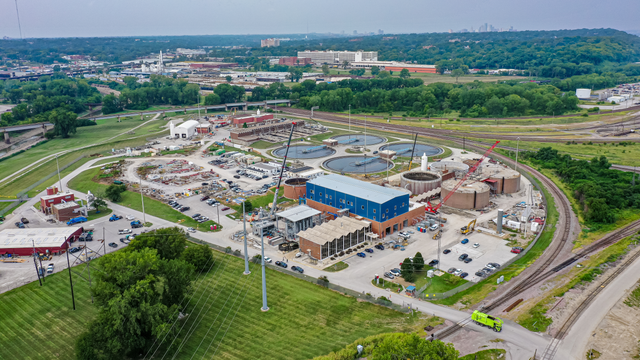
The Blue River Wastewater Treatment Plant (WWTP) handles flows and solids from across Kansas City's system. For decades, its 1960s-era incinerators burned what the plant produced — an approach that was expensive, inefficient and out of step with the city's sustainability goals.
The Kansas City Water Services Department set out to do more than replace aging equipment. Working with the Black & Veatch/Goodwin Brothers design-build team, the city built a complex, multi-process biosolids facility within the footprint of the operating plant — constructed on the very foundation of the demolished incineration building.
The project fundamentally shifted Kansas City's biosolids management from disposal to recovery. Gone are the incinerators and the air pollutants and greenhouse gas emissions they produced. In their place: efficient production of nutrient-rich biosolids suitable for agricultural and residential use, and a renewable energy stream that displaces fossil fuel consumption.
The circular-economy approach earned the Grand Prize in Design from the 2026 Excellence in Environmental Engineering and Science® awards competition.
Thermal Hydrolysis Process (THP) — the U.S. Midwest's first large-scale installation — is the engine of the new facility. The high-pressure, high-temperature process sterilizes and breaks down sludge before anaerobic digestion, dramatically improving digestion efficiency and process stability, increasing biogas yields and producing Class A biosolids that meet the highest quality standard for beneficial land application. A key advantage: THP allows the plant to process significantly more solids without adding digester capacity.
The design also incorporated sidestream deammonification — a biological process that removes nitrogen from wastewater return flows. Repurposed Dissolved Air Flotation tanks were converted into nitrogen-removal systems, reducing aeration demand and chemical use while keeping the plant in permit compliance as solids throughput increases.
Space on this active treatment plant is scarce. The project team maximized it by reusing existing digesters, holding tanks and facility corridors; upgrading mixing systems; and adding a flexible membrane cover for biogas storage on an existing tank. Consolidating what had been planned as three separate buildings into one reduced cost and streamlined operations.
International benchmarking tours informed equipment selection and process design, while rigorous building information modeling (BIM) standards ensured construction accuracy and laid the groundwork for long-term asset management.
The new biosolids facility was integrated into the footprint of the WWTP — constructed on the foundation of its demolished incineration building.
Fixed-price design-build kept the Kansas City Water Services Department and the Black & Veatch/Goodwin Brothers team aligned on shared risk, shared schedule and shared accountability. The collaboration delivered tangible results:
Early procurement: The THP system was pre-negotiated and ordered before COVID-driven supply-chain disruptions hit, avoiding months of potential delay.
Uninterrupted operations: Construction and commissioning were staged so the plant never stopped treating wastewater.
Incremental commissioning: New processes were introduced gradually, protecting biological digester performance and regulatory compliance at every step.
The Blue River project serves as a replicable model for utilities seeking to modernize aging facilities under constrained conditions. Through design-build delivery, strategic reuse of existing infrastructure and integration of advanced biosolids treatment technologies, the project demonstrates how thoughtful engineering and collaboration can extend asset life, improve performance and deliver long-term value for utility owners and the communities they serve."
Suzie Carpenter, Project Director, Black & Veatch

The facility delivers measurable improvements on three fronts:
Water: Enhanced digestion and sidestream nutrient removal improve effluent quality and support local watershed health.
Air: Incineration-era emissions were eliminated. Biogas is captured and made available for beneficial reuse through the natural gas system, displacing fossil fuels. Odor control measures further improved local air quality.
Land: Class A biosolids replace landfilling with beneficial land application, turning a waste stream into a nutrient-rich soil amendment that reduces reliance on synthetic fertilizers.
The project is pursuing Envision Silver verification, validating its sustainability performance against independent, third-party criteria.
The Blue River Biosolids Facility lowered the city's disposal and hauling costs, created revenue opportunities through biosolids reuse and future biogas sales, and advanced Kansas City's sustainability objectives. For utilities managing aging biosolids infrastructure on constrained sites, it offers a blueprint for integrated technology, practical engineering and collaborative design-build delivery, showcasing what critical infrastructure transformation can accomplish.