McCoys Creek: Nature-based, flood mitigation solutions transforming Jacksonville’s urban core

mccoys creek flood mitigation

Share this page:

Project Name
McCoys Creek Restoration Project
Location
Jacksonville, FL
Client
City of Jacksonville, FL

Like much of Florida, Jacksonville enjoys abundant sunshine — generally about 220 days a year. But it also sees significant rainfall, averaging roughly 52 inches each summertime. While most storms are manageable, downpours historically overwhelmed McCoys Creek, an urban drainage system and serial flood hazard near downtown.

For decades, floodwaters inundated nearby homes and streets, stranding motorists and forcing rescues that regularly made the evening news. Aging infrastructure and a constrained channel left the surrounding neighborhoods vulnerable — a stark example of how traditional stormwater management approaches can fall short in dense urban environments.

Today, that story is changing.

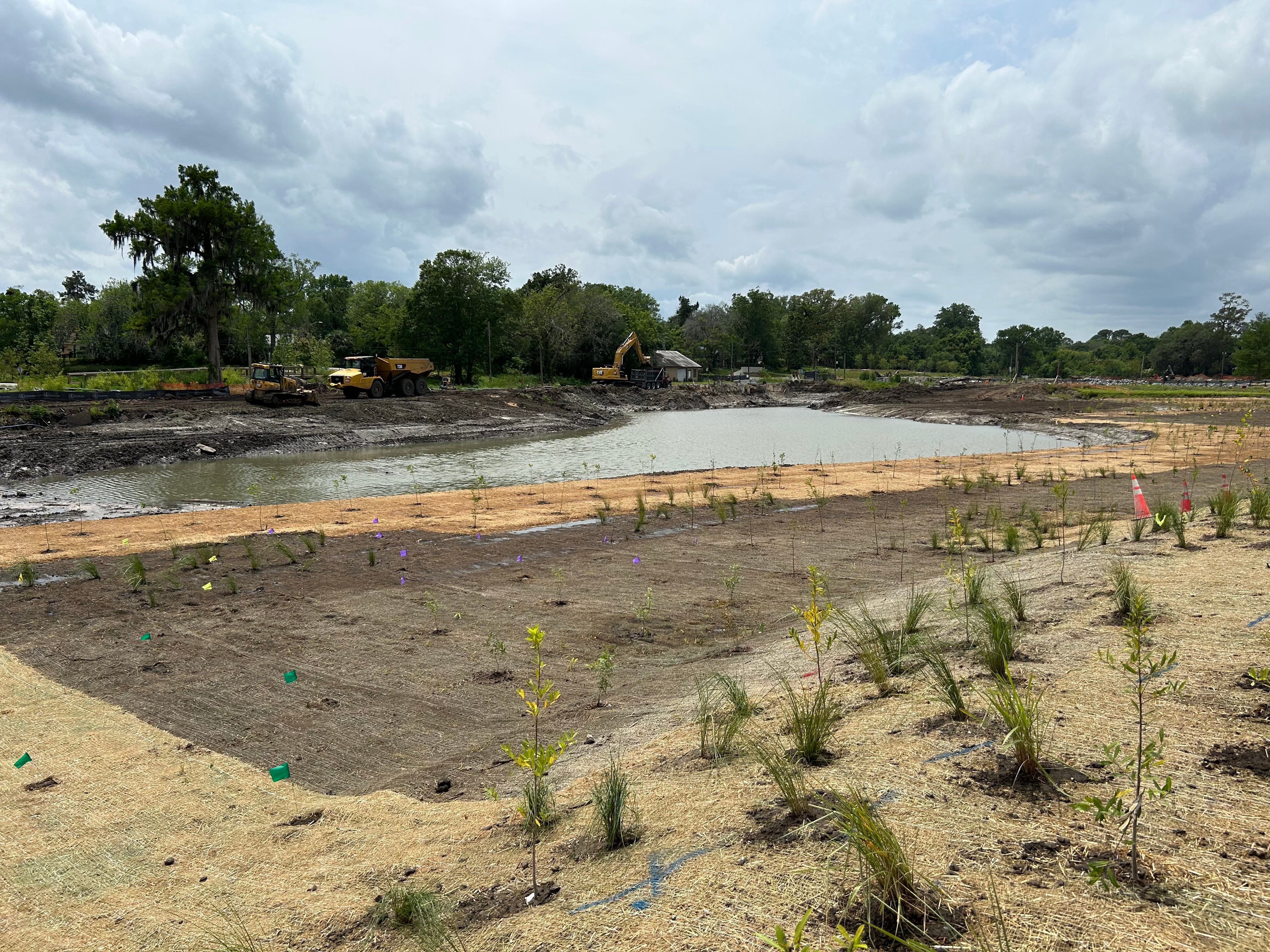
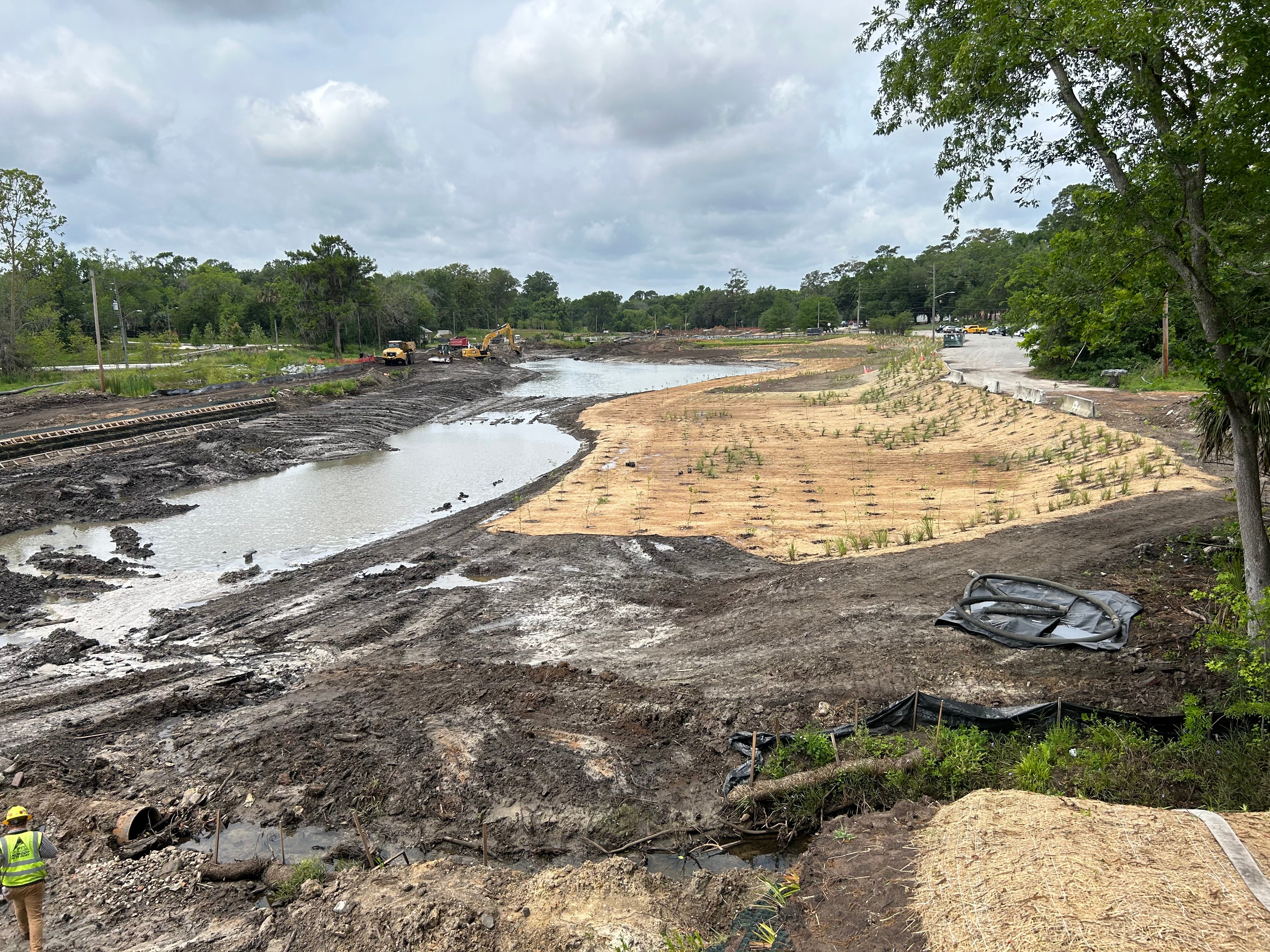
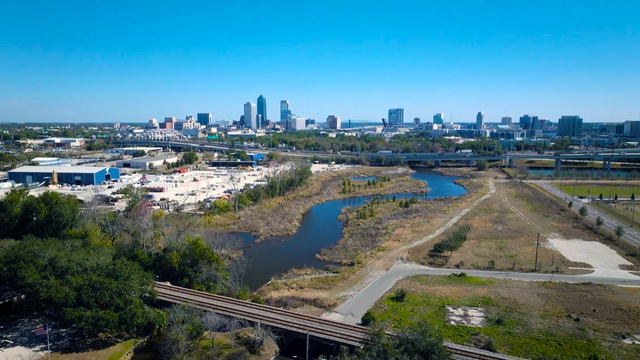
A bold vision is reshaping McCoys Creek through nature‑based infrastructure and green stormwater solutions. As part of a sweeping flood mitigation push, the former channelized, bulkheaded stream has been replaced with a wider, restored floodplain filled with native vegetation. Guided by Black & Veatch, the $105.4‑million restoration blends civil and structural engineering with ecological design, delivering a project rooted in urban resilience, environmental restoration and community‑driven change.

I’m an engineer — I rely on data and science — but connecting with the community has been powerful,” said John Kiefer, the project’s engineer of record for Black & Veatch, a WSP subcontractor. “Seeing how this project layers societal and environmental benefits inspires me. It’s about reconnection to nature and improving lives.”

$105.4
million investment
2.8
miles of restored creek
50
residential properties removed from flood zone
flood mitigation

From drainage ditch to living ecosystem

Once a natural waterway, McCoys Creek in the early 20th century began undergoing development that dramatically altered its course. Wetlands and floodplains were filled, rail infrastructure encroached on the corridor, and the final stretch of the creek was buried and piped through a tunnel to the St. Johns River. Municipal incinerator ash — considered hazardous today — was used as fill, creating long‑term environmental and public health risks.

The result was a straightened drainage ditch lined with deteriorating concrete and steel bulkheads — a system that failed repeatedly under heavy rainfall. For years, the proposed flood control solution was simply a larger, deeper ditch, an approach that lacked community support and offered limited long‑term value.

Instead, the city embraced a nature‑based solution meant to lower flood risk by restoring the creek’s natural meanders and reintroduced wetlands into the urban core. The goals were clear: reduce flooding, improve water quality, restore habitat, reduce flood damage and create recreational space — while unlocking millions in federal and state funding.

“This project is about so much more than moving dirt and water,” Jacksonville Mayor Donna Deegan said. “It is about resilience.”

flood control

Restoration and flood control, blessed by the community

From the outset, community engagement shaped the project. Groundwork Jacksonville, a nonprofit focused on sustainable urban development, partnered with engineers to listen to residents’ priorities — cleaner water, wildlife habitat and safe outdoor spaces for families.

“From the very first meeting, the community embraced the concept,” Kiefer recalled. “I got more hugs that night than at any public meeting I’ve ever attended.”

City leaders were convinced not just by community support but by data. Compared to traditional gray infrastructure, the restoration offered layered benefits — flood mitigation, ecosystem restoration, reduced maintenance costs and improved quality of life — while opening the door to significant outside funding.

Not all municipalities would have gone for this solution,” Kiefer said. “It took vision and leadership.”

mccoys creek

Impact beyond flood mitigation

The results already are visible. Dozens of homes and more than 100 public assets have been removed from the Federal Emergency Management Agency’s 100‑year floodplain. A bridge is now higher, as another span will be. Nuisance flooding has been dramatically reduced and aquatic habitat restored. Fish nurseries are forming, native plants are thriving, and the creek has reclaimed its natural flow.

“If you could see what's been constructed so far, you would be amazed by the transformation of the creek,” Groundwork Jacksonville CEO Kay Ehas has said. “The first time I saw it, my heart leapt.”

The project also supports a broader vision: the Emerald Trail, a 30‑mile network of walking and cycling paths connecting downtown neighborhoods — among the city’s oldest communities — to parks and greenways, reinforcing the role of green infrastructure in urban revitalization.

The quest to reduce flood risk: ‘An uphill battle’

To Nikita Reed, who has overseen the project since 2019, the transformation is deeply personal. As the city’s engineering operations manager who since 2019 has overseen the flood mitigation and restoration project, she wasn’t always certain what was achievable, knowing “you had to undo decades of manmade damage.”

But Reed sees a new reality emerging — one where heavy rain no longer means detours, swamped streets and flood damage. Once a stubborn flood hazard, McCoys Creek stands as a model for urban restoration, powered by community collaboration and at times compromise.

“It was an uphill battle,” said Reed, whose family has called one of the affected neighborhoods home since the late 1920s. “The city had starts and stops, different visions. As project manager, I pushed as much as I could, but sometimes I wasn’t sure how much we’d accomplish.”

Yet now, she marvels, “it fixes something I knew was wrong. To be part of the city doing something about it is very satisfying.”

Kiefer sees it as a reminder that beyond infrastructure being about concrete and calculations, it’s about creating spaces where people and ecosystems thrive together.

What’s surprised me is the emotional impact,” he said. “Building relationships in the community, seeing how this work reconnects people to nature. That’s powerful.

Contact Us

Looking for a partner in innovation?

Let's Talk
2 construction workers at solar site