2026 Water Report
Now in its 15th year, our annual survey of public agencies and utilities across the U.S. measures progress attacking issues, tracks market shifts and spotlights the emerging challenges and opportunities shaping the future of water.

Water is now a strategic business consideration across industrial sectors. Companies that wait until late in project development often find that availability, treatment requirements or system capacity has become the constraint, which is why more of them are treating water providers as partners, not mere suppliers.
Survey results from the Black & Veatch 2026 Water Report, which reflect the views of more than 600 U.S. water sector stakeholders, show how industrial demand patterns are changing:
59% of respondents reported increasing potable water demand from industrial activity
54% reported increasing wastewater treatment demand
46% reported increasing demand for recycled or reclaimed water
33% reported increasing demand for raw or untreated water supplies

Water scarcity, compressed development timelines and competition for allocated supply are showing up wherever heavy industry is expanding. And industrial demand everywhere is outpacing traditional water planning cycles. In addition, industrial usage efficiency and water sustainability efforts are not always properly characterized in the media and public forums.
Industrial users move on timelines compressed by global supply chains, economic development initiatives and market pressure, and their financial exposure is measurable. The Carbon Disclosure Project (CDP) identifies at least $77 billion (in U.S. dollars) under threat from water risk in corporate supply chains, with nearly $7 billion at immediate risk.
Water providers face pressures related to aging infrastructure, treatment requirements, evolving regulation, permitting, policy maker priorities, climate variability and community expectations, all of which must be resolved before they commit to a major new industrial load. Their obligation to deliver reliable service to existing customers does not pause while they evaluate a new one. These utility forces slow down processes where industry pressures dictate faster response – creating stress for all parties.
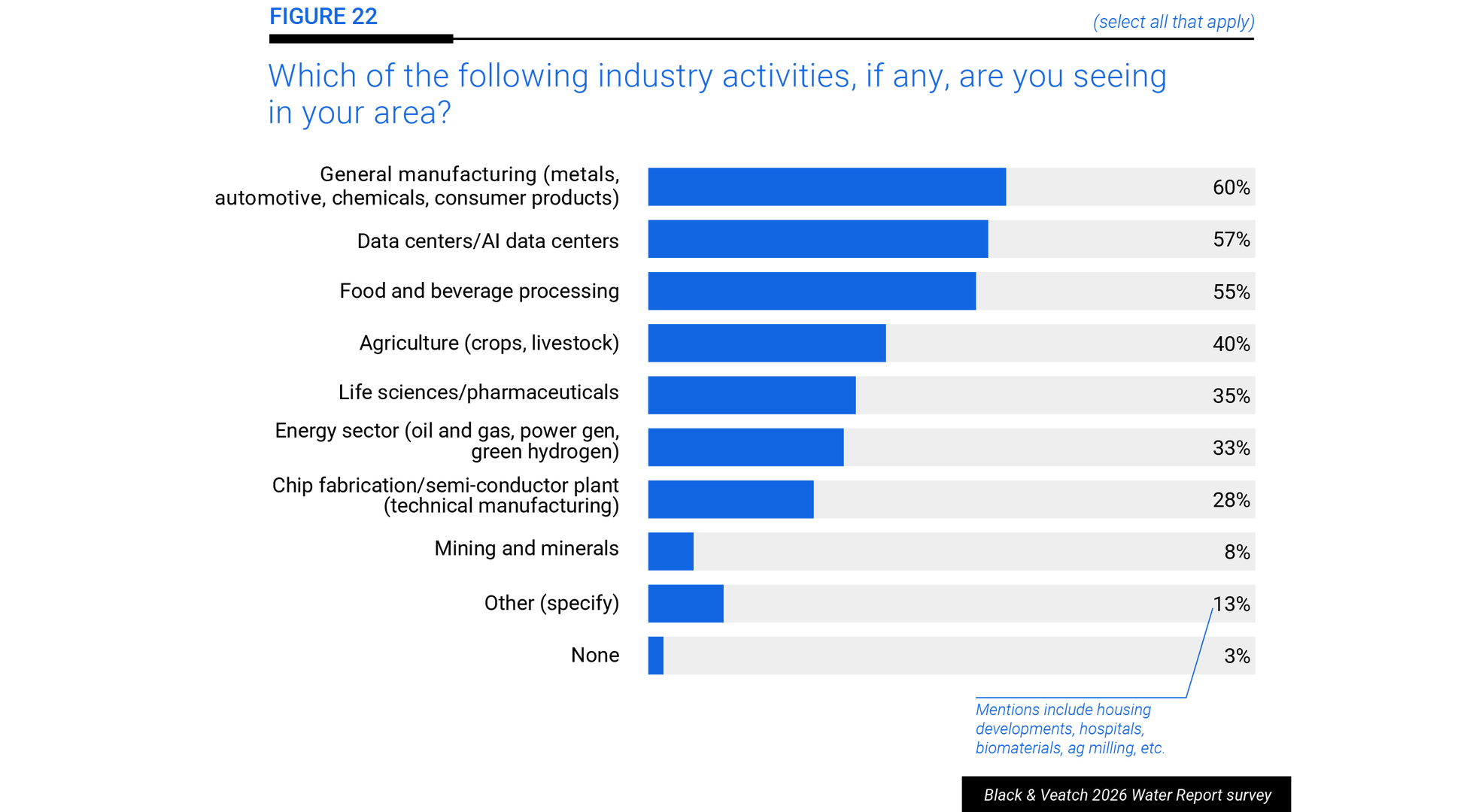
Nearly every industrial sector faces water-related pressure, but the nature of that pressure varies.
Data centers. Requirements vary widely with cooling technology, climate and site conditions. As data center development accelerates, operators and utilities are balancing water use, power availability, sustainability goals and community expectations while evaluating opportunities for alternative supplies and water reuse.
Semiconductors and advanced manufacturing. UltraPure Water (UPW) remains critical for yield and product quality, but the larger challenge is securing reliable long-term water supply and wastewater management capacity as new facilities scale. Water availability, reuse, community acceptance and utility partnerships are increasingly becoming strategic factors in site selection and expansion.
Food and beverage Reliable water supply and wastewater treatment capacity are essential for production growth, food safety and operational continuity. As facilities expand, water availability, discharge limitations, nutrient management and water reuse opportunities are becoming critical business and permitting considerations.
Mining and metals. Unlike most industries, mining often faces both water scarcity and excess-water risks. Reliable supply is needed to sustain production, while tailings water, contact water, pit dewatering, and stormwater management can create significant environmental and operational challenges. Water management is therefore a critical factor in permitting, stakeholder acceptance, operational performance, and long-term mine viability.
Chemicals, fertilizers and process industries. Rising water acquisition costs, discharge constraints and drought exposure are accelerating investment in water reuse, recycling and closed-loop systems as business continuity and cost-management strategies.
Three shifts change how companies may approach a siting or expansion decision.
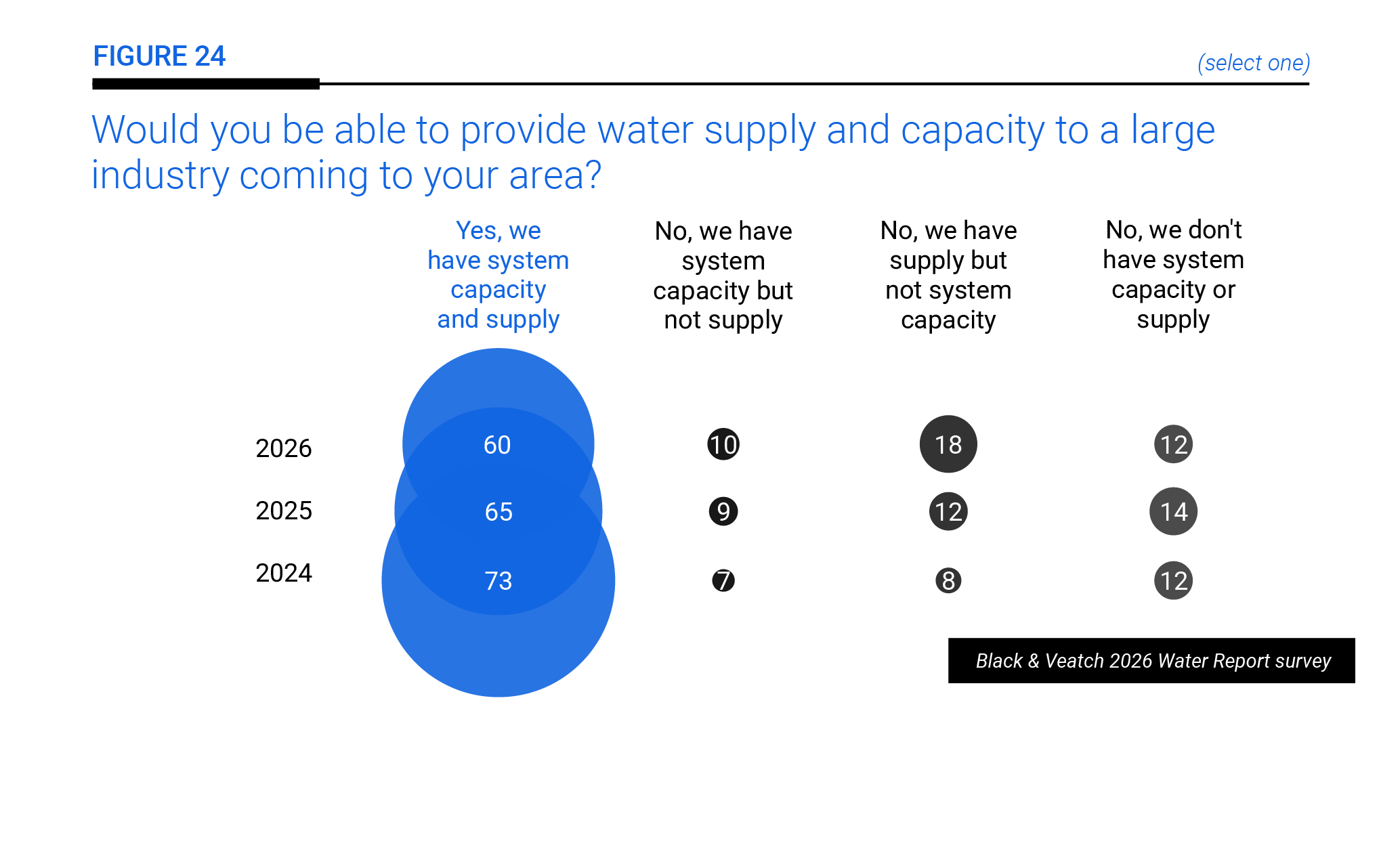
Availability cannot be assumed. Utility confidence in providing both supply and system capacity to a large incoming industry has fallen from 73% in 2024 to 60% in 2026, against planning horizons of 20 to 30 years. Two in five prospective providers are not confident they can serve a new large load, and one-third already report capacity constraints from high-volume industrial customers.
Water is becoming a site selection gate. Seventy-four percent of utilities are using or planning siting and connection criteria tied to water availability. The question is moving to the front of the process, where power already sits.
The cost basis is being repriced. Thirty-eight percent plan to change industrial water rate structures. Traditional industrial customers draw at consistent levels with minimal peaking; data centers do not, placing disproportionate pressure on system capacity and cost allocation.
Underlying all three is a change in posture. Utilities are moving from accommodation to strategy, and the terms of service are being set earlier and negotiated harder than they were two years ago.

The traditional relationship was transactional: services provider and customer. The new one is early, transparent, ongoing collaboration. It reflects the fact that water is a shared system, and how it is managed determines whether a project is approved, how fast it scales and what it costs to run. That recognition is pushing companies toward strategies that span supply, treatment, reuse, conveyance and discharge.
Early engagement lets both sides align on realistic supply and treatment capability, identify constraints before they become risks, develop scalable and cost-effective solutions, and balance facility requirements against long-term community priorities.
The obligation runs in both directions. Industrial users share clearer projections of demand and wastewater characteristics even as designs evolve. Utilities move from reactive responders to strategic participants in economic development.
Partnerships also have a contractual shape. An industrial user can make a capital or operational optimization contribution toward utility infrastructure — a recycled water plant, reducing system water loss, as examples — in exchange for obtaining secure, sustainable water supplies . The model is not theoretical: Large private water users are already co-investing in infrastructure that serves their own supply and operational needs.
Assessing supply, treatment and conveyance capacity early — and identifying alternative sources — gives companies and utilities real options before economic development commitments are final.
Industrial timelines can outrun utility capital planning cycles, and waiting on conventional expansion creates bottlenecks that delay projects or strain existing systems. Adaptive approaches are filling the gap. Think: phased infrastructure that meets near-term demand while scaling for the future, modular or temporary treatment that bridges immediate needs, and delivery models that accelerate design, permitting and construction.
Flexibility extends to the balance sheet, with some companies leasing treatment equipment rather than owning it. Collaborative delivery is expanding as projects grow more complex and timelines tighten, with progressive design-build valued for earlier risk visibility and stronger cost and schedule certainty.
In a community near Phoenix, Arizona, a major semiconductor manufacturer needed reliable, sustainable water supplies. The solution turned the manufacturer’s wastewater into a resource, with an advanced water reuse facility coming online in 2028 with the ability to recycle 90-percent or more of their water. The manufacturer secured reliable water, the utility protected its supply, and the community gained a reuse model that strengthened long-term resilience.
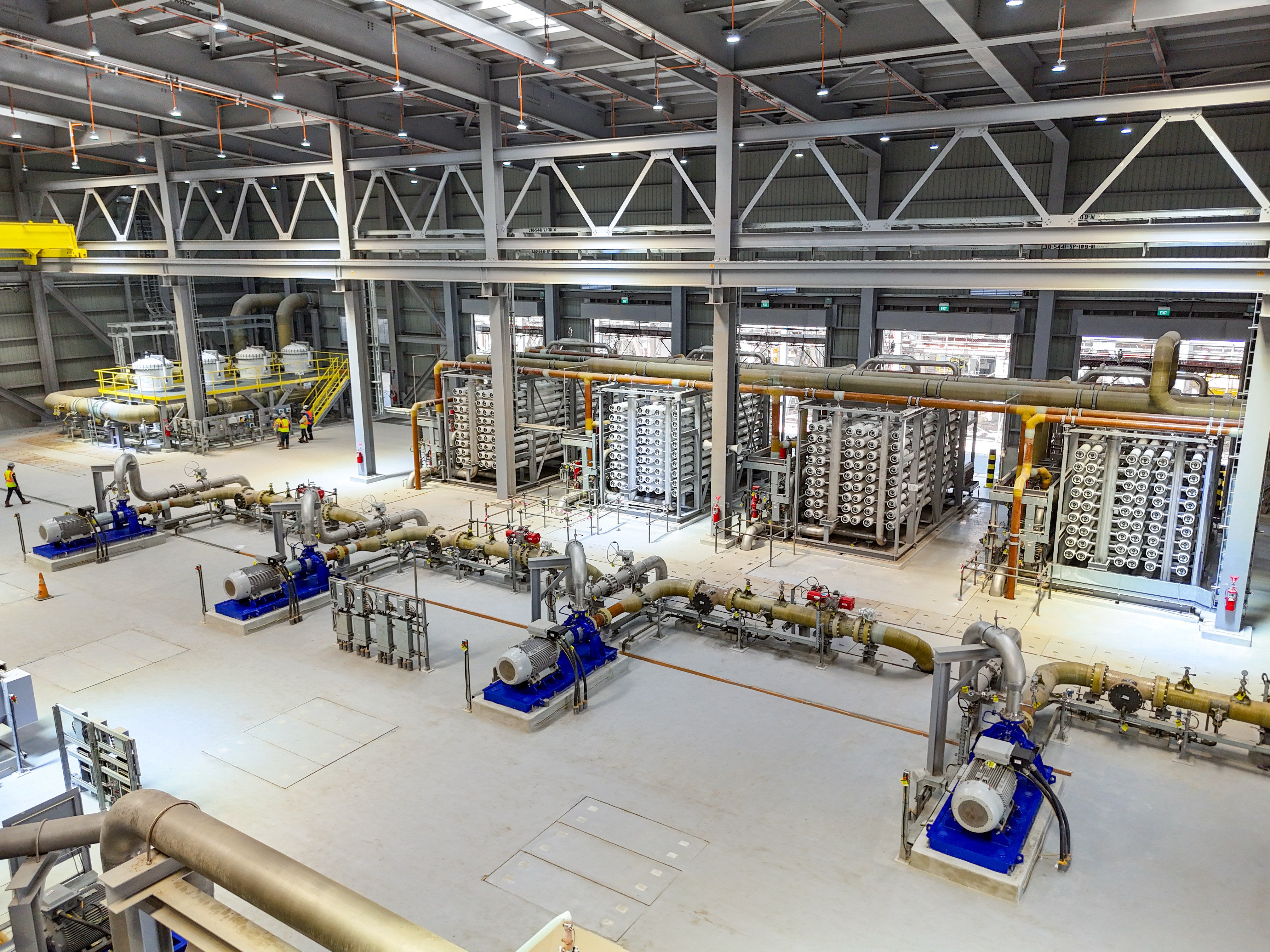
Where no utility connection exists, the delivery challenge can be greater. In Gresik, Indonesia, PT Freeport Indonesia’s Manyar smelter — supporting the world’s largest designed single-line copper processing facility — required a climate-independent supply on a constrained schedule. Black & Veatch delivered a 9.1 mgd (1,435 cubic meters per hour) seawater desalination plant under a full EPC model, from front-end engineering design through commissioning. It was the first EPC mining project of its kind in Indonesia, completed with 6.2 million hours worked without a lost-time incident.


Black & Veatch provided EPC services for the 9.1 mgd (1,435 cubic meters per hour) seawater desalination plant supporting PT Freeport Indonesia’s Manyar smelter operations.
Once-through water use is becoming less viable, particularly in resource-constrained regions. Reuse, recycling and circular systems are moving to the front of planning and operations because they reduce dependence on fresh and drinking water supplies, lower operating costs over time, improve drought resilience and support regulatory and environmental goals.
The runway is long. Only about 8% of freshwater withdrawn globally for industrial and domestic use is later treated for reuse and recycling — the clearest measure of how much value is still sitting in wastewater streams.
The cost logic makes this a margin decision. Large industrial customers evaluate total utility costs across water, wastewater, electric, gas and chemicals rather than any single component. As those costs rise, so does the incentive for processes and technologies that reduce water dependency.
Utilities are creating the opening. Among those implementing new projects now or planning to within 24 months, 62% are pursuing expanded reclaimed/recycled or non-potable supplies for industrial use and 59% are pursuing onsite reuse, closed-loop systems or zero liquid discharge.
Reclaimed/recycled water can not only serve irrigation, process water, cooling water, fire protection and aquifer recharge – but also potable uses for broader community benefits with added treatment. Zero liquid discharge or Minimum liquid discharge addresses both scarcity and discharge limits through a blend of wastewater minimization and cost-effective treatment — side stream softening, filtration, brine concentrators, crystallizers, dewatering and high-efficiency reverse osmosis. Where conventional freshwater sources are fully allocated, desalination of brackish groundwater, seawater or industrial process water is the other path, as the Manyar project shows.
In Corpus Christi, Texas, the city and Valero Refining-Texas signed a 30-year agreement for up to 8 mgd of reclaimed water for the refinery’s industrial operations — 3 mgd initially, with the balance available once infrastructure improvements are complete. (City of Corpus Christi, January 2026) The city is now building a $108 million pipeline to add 11 mgd of non-potable capacity for industrial users, lifting total reuse capacity to roughly 16 mgd. (Smart Water Magazine, August 2026)
One of Black & Veatch’s automotive manufacturing clients has set a goal to eliminate industrial water withdrawals by 2050 and reduce company-wide consumption through regional conservation and recycling. At its manufacturing campus, Black & Veatch evaluated end-of-pipe wastewater treatment and reuse, developing conceptual alternatives for combined and segregated streams to deliver a reliable, robust, and cost-effective recycled water solution."
Expect these terms at the table. As data center investments continue to grow, utilities and developers are evaluating a range of water-related considerations, from supply and treatment requirements to discharge management and long-term consumption strategies. Solutions like these succeed only through close coordination, from system design through long-term operation.
For industrial users, the first move is concrete: Pull water forward in project planning and treat it as a gating factor, the way power already is.
Start with a comprehensive water mass balance that tracks both flow and water quality across all major users in the facility. That is the step that makes an economic evaluation of water use efficiency, reuse and treatment alternatives possible. Then put a number on it. A water valuation accounts for hard factors such as production rates, sources, water losses, energy and chemical impacts, conveyance and treatment requirements alongside softer ones including climate and regulatory change, supporting business continuity and investment decisions. From there, engage utilities to understand their supply sources and alternatives, treatment capabilities, conveyance capacity and public support.
That last conversation is the one that companies can underestimate. Utilities operate at the intersection of businesses, residents, regulators and local governments, and an expansion that compromises service reliability for existing customers, conflicts with sustainability commitments or runs against community values will show up as delay on the project schedule. Industrial partners that engage on the community case as readily as the technical one — economic development, job creation, responsible stewardship — share in the trust utilities earn rather than competing against it.
The industrial water equation has changed. Companies that engage early and help shape practical solutions will be better positioned to secure the water their growth depends on.